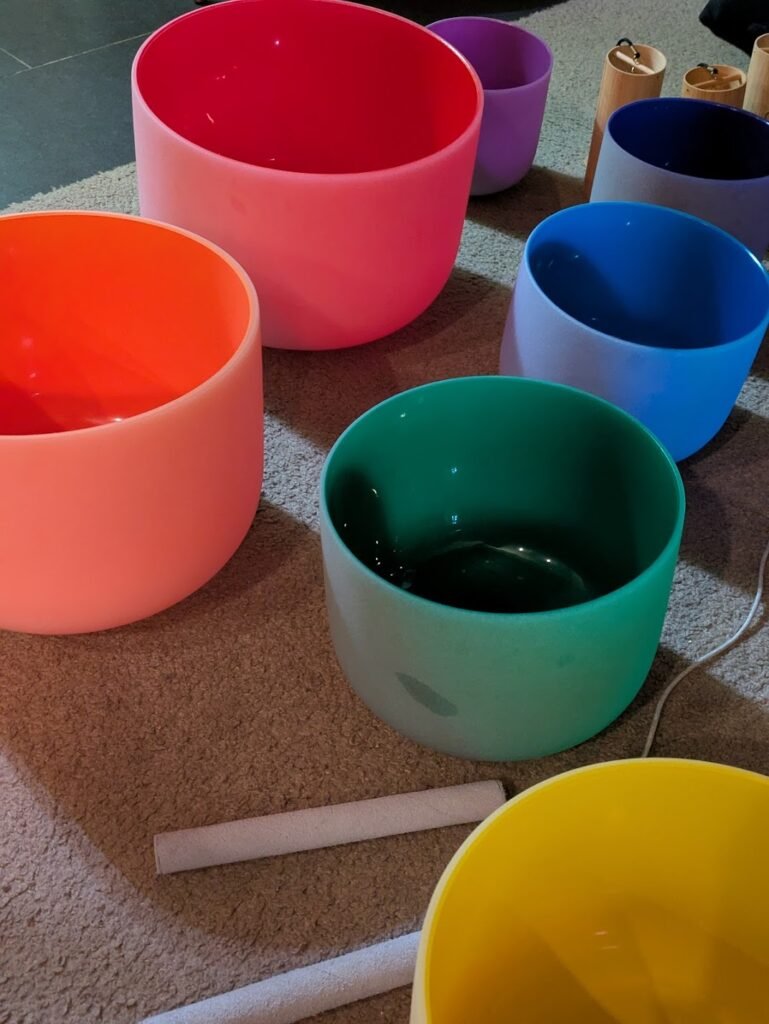
In the age of AI anxiety, we hold bowls made from computer chip materials, trying to find calm.
This is not a story of ancient wisdom versus modernity. This is modern technology healing itself—silicon cycling through different forms, from tools of production to media of rest.
The Journey of Matter: From Chips to Sound
Crystal singing bowls were born in 1980s Silicon Valley, in semiconductor factories rather than meditation centers. Engineers used 99.992% pure silica sand to create quartz crucibles, containers for growing silicon crystals—the raw material for computer chips. The production process demanded extremely strict purity standards: any impurity exceeding 0.005% would affect chip quality, leading to entire batches of crucibles being rejected. These “defective” products were discarded by the semiconductor industry until musicians accidentally discovered: when struck, these containers produced an exceptionally clear, sustained sound.
This discovery marked the material’s transmigration. During the 4000-degree melting process, quartz’s crystalline structure is destroyed, its originally ordered silicon-oxygen tetrahedra losing regularity to become amorphous glass. From a materials science perspective, these bowls are no longer crystal; they no longer possess natural quartz’s piezoelectric properties—those qualities believed to “store and conduct energy.” Calling them “crystal” is actually a linguistic misdirection. These bowls are high-purity silica glass products; their acoustic properties come from industrial-grade material purity, precise geometric symmetry, and glass’s own resonance patterns in specific shapes. The beauty of this sound comes from precision engineering, not mysticism.
Interestingly, this ambiguity in material identity precisely creates new possibilities. When industrial waste is rediscovered as a carrier of sound, silicon undergoes a transformation of meaning—from serving computation and production to serving rest and presence. The same material, in different contexts of use, carries completely opposed functions. This transformation is not only physical (from crucible to bowl) but also semiotic (from technology to spirituality, from production to healing). And this semiotic transformation depends precisely on a certain obscuring of material truth.
Bowl as Synthesizer: Oscillation and Generation
If we temporarily set aside the metaphysics of “crystal energy” and look at these bowls from a sound technology perspective, we find an interesting parallel: crystal singing bowls work similarly to oscillators in synthesizers.
When a bowl is struck or rubbed, the glass material begins to oscillate at its natural frequency. This frequency is determined by the bowl’s size, thickness, and material density—larger bowls produce lower frequencies, smaller bowls produce higher frequencies. This fundamental frequency is usually very pure and stable, similar to the basic waveform produced by a sine wave oscillator. Meanwhile, due to the bowl’s geometric shape and material properties, the oscillation produces a series of overtones—these are integer multiples of the fundamental frequency, layering together to create that rich, sustained timbre.
More accurately, this is a form of droning—a sustained tone, continuous, unresolved, diffusing through space. Drone has a long history in different musical traditions: the tampura in Indian classical music provides a sustained drone as the foundation for raga, the drone pipes of Scottish bagpipes continuously emit a fixed pitch, La Monte Young’s The Well-Tuned Piano extends drone to hours. Drone is not about melodic development or harmonic progression; it’s about immersion in a single sonic field, letting consciousness settle down in that sustained vibration.
In a sound healing session, the bowl player/sound healer’s role is similar to a drone music performer. They are not “playing music”; they are creating and maintaining a sonic environment. Through controlling the pressure, speed, and angle of friction, through choosing when to let one bowl fade out and when to introduce another frequency, they are shaping a continuously changing yet always present sound field. This process requires extreme sensitivity—to the material’s response, to the space’s acoustics, to the audience’s energy attunement.
This droning sound field subtly changes with the bowl player’s breath. When they inhale, hand pressure subtly increases, the sound brightens; when they exhale, pressure releases, the sound softens. This is not deliberate control but embodied practice—the performer’s breathing rhythm naturally transmits into the sound’s envelope. This micro-variation creates a living quality, preventing the sustained tone from becoming mechanical or hypnotic in a negative way. The coupling between sound and breath makes this experience fundamentally embodied, for both performer and listener.
This process is remarkably similar to sound generation in West Coast synthesis—particularly modular synthesizers designed by Don Buchla. In Buchla’s system, complex oscillators don’t just produce basic waveforms; they can modulate each other, creating evolving, organic timbres. This approach emphasizes timbre and texture over melody and harmony, emphasizes real-time performance over programmed sequences. The bowl itself is a physical West Coast synthesizer—material density and elasticity function as complex oscillators, the bowl’s geometric shape functions as a waveshaper, and the performer’s touch (strike force, friction speed, breathing rhythm) becomes a live modulation source. When multiple bowls sound simultaneously, the beating frequencies and phase interactions between them create continuously shifting sonic textures—essentially no different from multiple oscillators cross-modulating in a Buchla system—both are creating living, breathing sound fields.
From this perspective, calling these bowls “crystal” rather than “glass,” attributing their sound to “energy” rather than “oscillation,” is a deliberate re-enchantment. In a world dominated by technological rationality, we need to give physical processes transcendent meaning, need to believe there is something beyond frequencies and amplitudes. This need itself deserves serious consideration—it is not “wrong science,” it is a necessary part of human meaning-making.
The correspondence between sound and body, cosmos has a long tradition in different civilizations. The seven notes in Indian music theory (Sa, Re, Ga, Ma, Pa, Dha, Ni) directly correspond to the seven chakras—from root to crown, each note is believed to activate a specific energy center. The five tones in Chinese medicine theory (gong, shang, jue, zhi, yu) correspond to the five elements (earth, metal, wood, fire, water), which in turn correspond to five organs (spleen, lungs, liver, heart, kidneys). These systems establish mapping relationships between sound, body, and cosmos—they are not arbitrary associations but correspondences verified through centuries of practice.
Contemporary sound healing often borrows these traditional frameworks—C note corresponds to root chakra, E note to solar plexus—creating a hybrid healing system. This borrowing is sometimes criticized as cultural appropriation or new age eclecticism. This criticism has its merits, yet it also misses a deeper insight: all these correspondence systems—Indian raga-rasa (emotion) correspondences, Chinese musical tuning-seasonal correspondences, Western mode-affect correspondences—they are all doing the same thing: trying to establish systematic relationships between frequency and experience. They are all saying: sound is not merely physical oscillation, sound is also a carrier of meaning, sound patterns can shape consciousness and bodily states.
From this perspective, the continuity between modern frequency generators and ancient singing bowls becomes clear. When we use specific Hz to “tune” the body (for example, 432 Hz is considered “natural tuning”), what we’re doing is essentially the same as ancient practices using specific scales to regulate qi and blood—both believe sound frequencies can intervene in the body’s energetic states. This belief may not be reducible to simple physico-chemical mechanisms; it involves more complex psycho-physiological and cultural-symbolic processes.
More fascinating are the correspondences between digital and analog. The cosmic flicker—the birth and death of stars, the radiation and absorption of energy—can be understood as a cosmic oscillation, a grand on/off rhythm. Human breathing—inhalation and exhalation, filling and emptying—is this cosmic rhythm’s manifestation at the individual scale. Contemporary digital technology is based on binary code—0 and 1, on and off—this most basic digital logic surprisingly echoes the most ancient cosmology: yin and yang, light and dark, the alternation of being and void. The so-called “unity of heaven and humanity” is perhaps not pre-modern superstition but a profound insight: there exists some isomorphism between the universe’s basic structure and human consciousness’s basic patterns, some structural correspondence.
Digital synthesizers and crystal singing bowls are both operating at this fundamental level—they are both generating and modulating oscillations. One uses electrical circuits, one uses material vibrations; one through binary operations, one through physical resonance. They are both introducing certain patterns—frequency, rhythm, timbre—into space and body. From this perspective, the opposition between technology and spirituality dissolves. They are both working with vibration, both operating patterns, both trying to affect consciousness through sound. The difference lies in framework and language, in how we story this process, in what meanings we assign to these oscillations.
Production Chains and Value Constitution
All crystal singing bowls—without exception—are manufactured in China. This fact is carefully obscured in wellness industry marketing. Many brands sold in the American market, even if they claim “American design” or “American quality control,” still complete their production stages in China. On Alibaba, the same specification frosted bowls wholesale for $50 to $200; in the American retail market, identical bowls sell for $400 to $2000. The price difference stems not only from shipping, taxes, and retail markup, but more importantly from narrative’s added value.
This narrative contains several layers. First is material narrative: the naming transformation from “silica glass” to “quartz crystal,” the identity reconstruction from “industrial by-product” to “sacred object.” Second is origin narrative: Chinese factories are made invisible, replaced by “handcrafted in USA” or the more vague “sourced from sacred sites.” Third is craft narrative: so-called “alchemy bowls”—claimed to incorporate gold, platinum, gemstone powders—actually employ vapor deposition technology, a standard industrial coating process identical to phone screen coating. Metal powders are heated to vaporization in a vacuum environment, then deposited on the glass surface to form a coating several microns thick. This does subtly alter the bowl’s acoustic properties (because surface quality and vibration damping change)—this is a physical effect. Between an ordinary frosted bowl and a 24k gold alchemy bowl, the physical difference is that metal coating layer; the price difference can reach $3000.
This price structure reveals the core mechanism of capitalist alchemy: value is not determined by labor time or material cost, but by symbolic capital. An object’s price depends on how much meaning it can carry, how much desire it can satisfy, how much distinction it can provide. The wellness industry understands this well: it is not selling glass bowls but promises of authenticity, possibilities of transformation, and connection to some imagined “ancient wisdom.” Purchasers pay for this symbolic system, carefully constructed around selective disclosure of material truth.
“Made in China” must be erased because it disrupts the narrative of authenticity. In the new age market’s imagination, authentic things should be hand-made, small-batch, from exotic locations (Tibet, India, or some spiritual hub in America). Assembly lines, industrialization, Chinese factories—these signifiers belong to mass production and alienated labor; they are incompatible with spiritual healing discourse. This erasure is not merely commercial strategy; it reflects a deeper contradiction within the wellness industry: it tries to create anti-capitalist spaces within capitalism, tries to provide de-commodified experiences through marketized means.
Paradox as Diagnosis: Technology’s Self-Healing
When people come to sound baths, they usually bring clear intentions: to withdraw from screens, to rest from information overload, to find moments of autonomy from algorithmically driven life. Wellness industry discourse encourages this understanding—it positions technology as the problem, “returning to nature” as the solution. This binary framework is neat, intuitive, easily marketable. It is also fundamentally misleading.
The tools we use to “escape technology” are materially identical to the technology we’re trying to escape: iPhone chips are silicon, laptop processors are silicon, data center servers are silicon, and this singing bowl is also silicon. We haven’t left technology to enter some natural or pre-technological realm; we’re only moving between different configurations of technology—from computation to resonance, from screen to sound, from interactive interface to auditory immersion. This movement is real; it does create different experiences, producing different effects at the neurophysiological level. Sound waves’ physical vibrations activate the parasympathetic nervous system, sustained single stimuli induce trance-like states, focus on auditory input lets discursive mental activity temporarily quiet down. These are all measurable, repeatable phenomena.
This paradox—using silicon to heal silicon anxiety—is not a logical problem that needs to be “solved”; it is a diagnostic tool for understanding our true relationship with technology. This paradox tells us: technology is not a threat external to us; technology is our environment, our extension, our condition. The problem is not technology itself, but how specific technological configurations are organized, used, and made meaningful. The same silicon, in one configuration, produces anxiety (endless notifications, algorithmic feeds, surveillance); in another configuration, produces calm (sustained tones, resonance, presence). What matters is configuration, not material.
This means wellness practices are not providing “escape from technology”—that is an impossible promise. What they provide is technology’s alternative uses—using the same materials, the same physical processes, to create different experiential outcomes. This is technology’s internal reconfiguration, not technology’s external transcendence. When we recognize this, we can stop romanticizing some imagined pre-technological Eden and start seriously thinking: what kinds of technological configurations do we want? What kinds of material arrangements can support the life we want to live?
Agency Within Conditions
Sound healing’s rise is not an isolated phenomenon; it is part of the wellness industry’s rapid expansion—this industry’s annual revenue in the US has exceeded $1.5 trillion. This expansion occurs at a specific historical moment: neoliberal capitalism’s deepening leads to public services’ privatization, mental health support’s responsibility shifts from social structures to individual self-care. When therapy is too expensive, when the healthcare system is inadequate, when workplace stress is overwhelming, the wellness industry provides market-based solutions: yoga classes, meditation apps, sound baths. This industry’s growth is not because people have suddenly become more “spiritual,” but because structural conditions have produced massive demand for coping mechanisms.
In this context, simply critiquing the wellness industry as “commodification of spirituality” is insufficient. While this critique is true, it also obscures a more complex reality: within this commodified framework, there are still real needs being addressed, real experiences happening. When an exhausted person lies in a sound bath space, when sound begins to flow, when breathing gradually slows down—this moment has its own integrity. The market creates the conditions for this moment (space, time, permission); the market also profits from this moment. These two facts coexist; they don’t mutually cancel out.
This means we need a more nuanced approach—both acknowledging the wellness industry’s problematic aspects (commodification, cultural appropriation, class privilege) and recognizing the genuine value it provides under current conditions. This is not resignation; this is strategic thinking. Within a system we cannot immediately overthrow, how do we create more humane spaces? How, under market logic’s constraints, do we protect experiences that shouldn’t be completely marketized?
This question has no simple answer. Some practitioners choose to work within the system, charging market rates, using established marketing channels. Some choose to create alternative structures, sliding scale pricing, community-based models. Both approaches have their rationality and limitations. What matters is maintaining awareness: awareness of the conditions we’re operating in, awareness of who benefits and who’s excluded, awareness of what gets lost when experience becomes transaction.
Honesty becomes a key ethic. When we know these bowls are glass not crystal, are mass-produced not handcrafted, are Chinese-made not American—how do we frame this knowledge? Do we maintain the mystification for commercial reasons? Or share the truth, risking market appeal? This is not only a question of personal ethics; it concerns what kind of relationship we want to build—with our clients, with our materials, with the broader culture.
I believe in the power of sound healing, this belief based on direct experience and physiological evidence. Sound waves’ vibrations do affect the nervous system, sustained resonance does induce altered states, communal listening does create shared presence. These effects don’t need “crystal energy” to validate them; they have solid scientific basis. At the same time, I also recognize ritual’s importance, recognize humans need stories and symbols to make sense of experiences. The key is finding a balance—between scientific understanding and poetic meaning-making, between market necessity and ethical practice, between honesty and magic.
This balance is hard to maintain. It requires constantly navigating contradictions, constantly making micro-decisions about what to reveal and what to bracket. It also requires accepting that there’s no pure position—we are all within this system, we are all implicated in its logics, even as we try to create spaces of resistance or alternative. This acceptance is not cynicism; this is clarity. Only when we clearly see our conditions can we effectively work within and against them.
Silicon’s Cycle: Material Poetics
Silicon’s journey traces a circular path: extracted from deep in the earth’s crust, purified to 99.992%, melted at 4000 degrees, shaped into containers for chip production, judged defective, discarded, rediscovered by musicians, marketized as spiritual objects, purchased for meditation and healing. This is a complete cycle—from earth to industry to waste to art to commodity. Each stage is a transformation; each transformation redefines this material’s meaning.
This cycle is not metaphor; this is literal material history. Silicon maintains its physical properties throughout this process—its atomic structure, its melting point, its acoustic characteristics. What changes are the human meanings attached to this material: from raw resource to industrial input to waste to sacred object. This transformation of meaning demonstrates a fundamental fact: materials themselves have no intrinsic meaning; meaning is always produced through specific social, cultural, and economic contexts.
In this sense, calling these bowls “crystal” is not simply misnomer. This is a performative act—through naming, we try to transform material’s social life, giving it different value and significance. This naming is part of the broader practice of enchantment, recreating wonder and mystery in a disenchanted world. The question is not whether this enchantment is “real” or “fake”—that’s the wrong question. The question is: what purposes does this enchantment serve? What kinds of experiences does it enable? What kinds of realities does it obscure?
Silicon Samsara—silicon’s cycle—this phrase is not just a poetic metaphor. Samsara in Buddhist tradition refers to the cycle of existence, characterized by suffering and illusion. Samsara is not circular return to the same, but continuous transformation through different states, each state conditioned by previous states. Silicon’s samsara similarly is not simple circulation but a process of continuous transformation, each transformation carrying traces of previous uses while opening up new possibilities.
From chip production to sound healing, from accelerated computation to suspended listening, from generating anxiety to providing peace—these transformations reveal silicon’s plasticity, its capacity to be configured in radically different ways. This plasticity is material and also social. The same substance can be organized to serve extraction and accumulation, and can be organized to serve rest and restoration. This choice—how we configure our materials, how we organize our technologies—this is a political question, disguised as a technical or spiritual question.
This recognition does not diminish healing practices’ value; it actually grounds them in material and historical reality. We don’t need to appeal to mystical energies or ancient wisdom to justify these practices. Their value lies in their actual effects—physiological, psychological, social. They create spaces where people can temporarily suspend their performative roles, where they can allow themselves to just be, where they can experience a different temporal rhythm. These spaces are precious, especially in a culture that demands constant productivity and self-optimization.
But these spaces’ preciousness does not exempt us from critical thinking. Precisely because they matter, we need to be honest about their conditions of possibility, about who has access and who’s excluded, about what gets romanticized and what gets erased. This honesty does not destroy magic; it makes magic more durable, because it’s grounded in reality rather than fantasy.
At this moment in 2026, AI has permeated into the fabric of daily life, anxiety has become a chronic condition. More and more people seek spaces of pause, seek moments not governed by optimization logic. Sound healing provides such a possibility—not an ultimate solution, but a tactical intervention.
I believe in this practice’s value, this belief coming from understanding it as what it is rather than what it claims to be. These bowls are industrial products, their sound is produced by physical oscillation, their effects can be explained by neuroscience. This knowledge does not diminish experience; it actually enriches understanding. We can choose to enter this space in a fully informed state; we can understand the mechanics while still allowing ourselves to be carried away by sound.
Silicon continues its cycle. From production to rest, from acceleration to pause, from computation to resonance. This cycle reveals: the same materials can be given different meanings, can serve different purposes, can create different worlds. Technology is not a single destiny; what matters is how we configure it, how we use it, how we relate to it.
When we lie down in a sound bath, when we hear that sustained tone, when our breathing begins to sync with the sound waves—what we’re doing is not escaping technology; what we’re doing is experiencing an alternative configuration of technology. This configuration is not perfect; it is embedded in market logics; it carries various contradictions. We can still choose to enter it, because within its contradictions, there is real rest, there is temporary peace, there is a moment where we don’t have to be productive, don’t have to be optimized, don’t have to be anything other than present.
Sound is still resonating. We are still listening. This is what we’re doing, under our available conditions.
A Practice
After you’ve read this essay, if anxiety remains, if understanding is not enough—
Go to your kitchen. Find a ceramic bowl, or a glass cup.
You don’t need “crystal.” You don’t need to spend $3000. Just a bowl you eat from.
Tap the bowl’s rim gently with your knuckle. Listen to that sound unfold in space. Notice how it spirals within the bowl, how it decays in air.
Or, simpler still: allow yourself to produce a humming. Any pitch is fine. Feel your vocal apparatus—throat, oral cavity, nasal cavity—vibrating. That vibration starts from your vocal cords, transmits to your skull, transmits to your chest. Your body is the oscillator.
This is the same physical principle. Material resonance. Oscillator generation. The meeting of frequency and body.
You don’t need to believe in “crystal energy.” You don’t need to align chakras. You only need to listen.
Listen to that sustained tone. Let your breath follow it. Not deliberately adjusting breath, but noticing how breath naturally synchronizes with sound.
Maybe three minutes. Maybe five minutes. No rules.
This is not a cheap substitute for “real” sound healing. This is sound healing—material oscillating, body responding, consciousness finding a temporary anchor in that sound.
When you set down the bowl, silence will seem different. More spacious.
This difference doesn’t come from any mystical transmission. It comes from giving yourself permission to pause, from your nervous system having a chance to down-regulate, from not needing to be anything other than listening for a few minutes.
You already possess the tools you need. They’re in your kitchen.
Silicon’s cycle continues in your bowl. Glass, ceramic, metal—they can all oscillate, all produce sound, all create that moment of pause.
What matters is not material’s origin story, not the spiritual narrative assigned to it.
What matters is: you stopped. You listened. You breathed.
You don’t need to wait for a sound healer to guide your breath. Deep breathing has always been within your own body.
References
Spaulding, Barbara. “The Truth About Crystal Singing Bowls.” A Sound Healing, January 22, 2025. https://www.asoundhealing.com/post/the-truth-about-crystal-singing-bowls
“Crystal Tones – Alchemy Singing Bowls.” Bowls of Sound, September 9, 2024. https://bowlsofsound.com/blogs/news/crystal-tones-alchemy-singing-bowls
Wind Music (風潮音樂). “三分鐘帶你認識水晶療癒樂器:水晶缽、水晶豎琴、水晶聲波琴” [Understanding Crystal Healing Instruments in Three Minutes: Crystal Bowls, Crystal Harps, Crystal Xylophones]. Vocus, April 8, 2024. https://vocus.cc/article/66134ba1fd89780001ffc904
“Crystal Singing Bowl Suppliers.” Alibaba.com, accessed February 2026. https://www.alibaba.com/trade/search?SearchText=crystal+singing+bowl
Leave a Reply